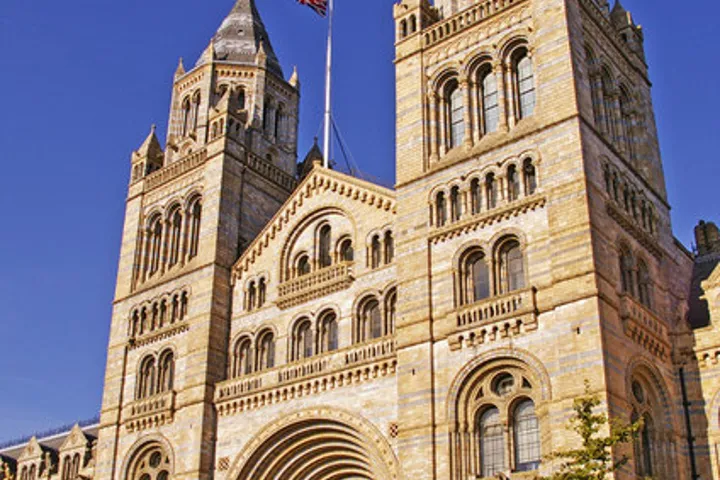
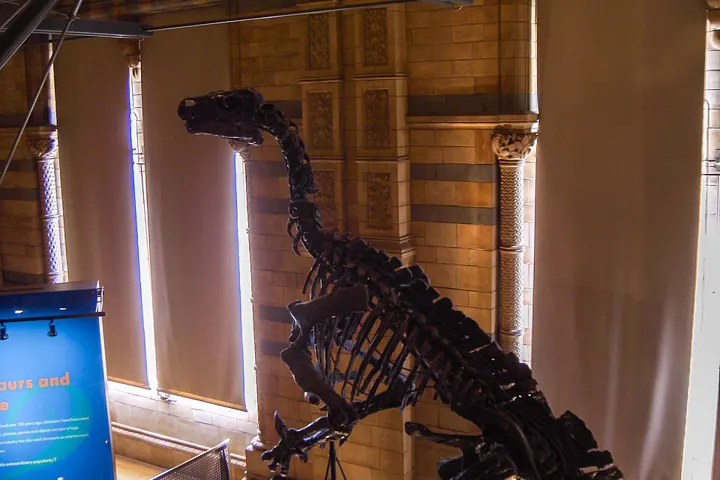
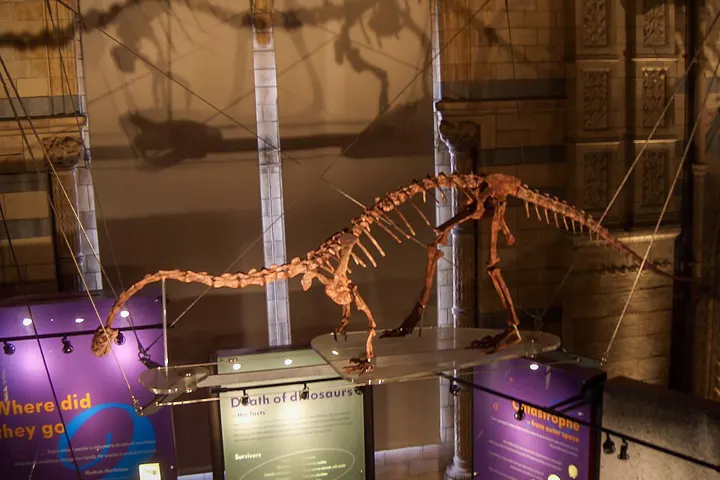
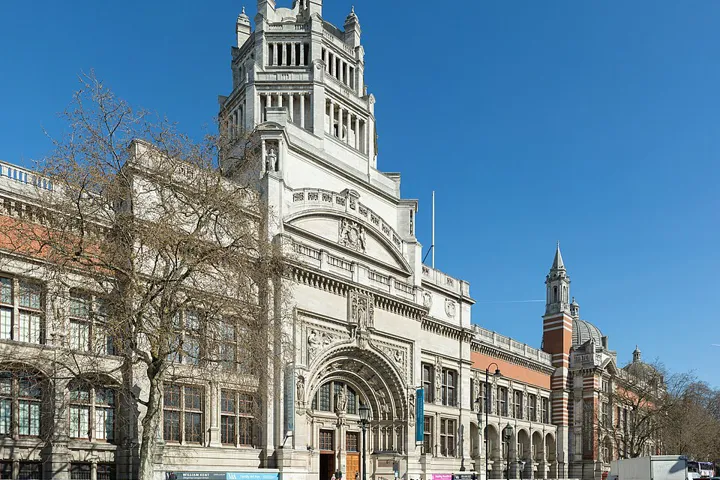
Alfred Waterhouse decorated the building with animals and plants on its terracotta façade, and every column is ornamented differently. A blue whale skeleton hangs in the hall, and beyond it galleries lead to dinosaurs, minerals and volcanoes. An escalator through a giant globe takes you into the section on the Earth and earthquakes. The Exhibition Road entrance often has shorter queues than the main entrance.
Background
The Natural History Museum in London, England, is a museum that exhibits a vast range of specimens from various segments of natural history. It is one of three major museums on Exhibition Road in South Kensington, the others being the Science Museum and the Victoria and Albert Museum. The Natural History Museum's main frontage, however, is on Cromwell Road.
The museum is home to life and earth science specimens comprising some 80 million items within five main collections: botany, entomology, mineralogy, palaeontology and zoology. The museum is a centre of research specialising in taxonomy, identification and conservation. Given the age of the institution, many of the collections have great historical as well as scientific value, such as specimens collected by Charles Darwin.
From Wikipedia: “Natural History Museum, London”, licence CC BY-SA 4.0